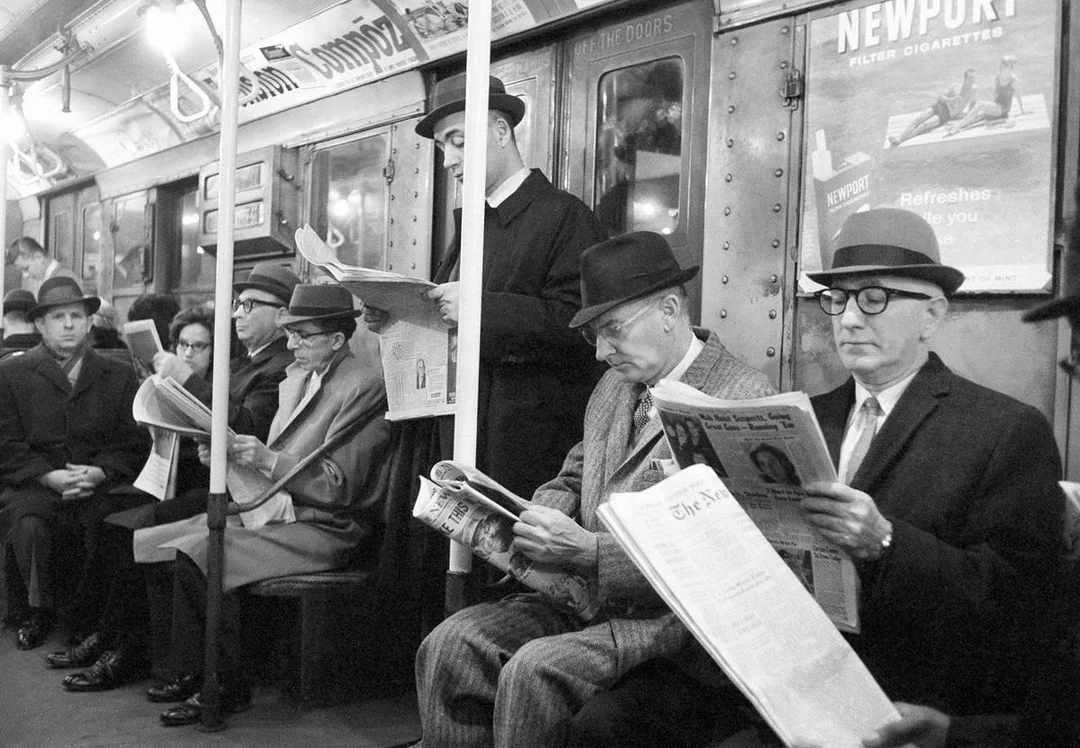
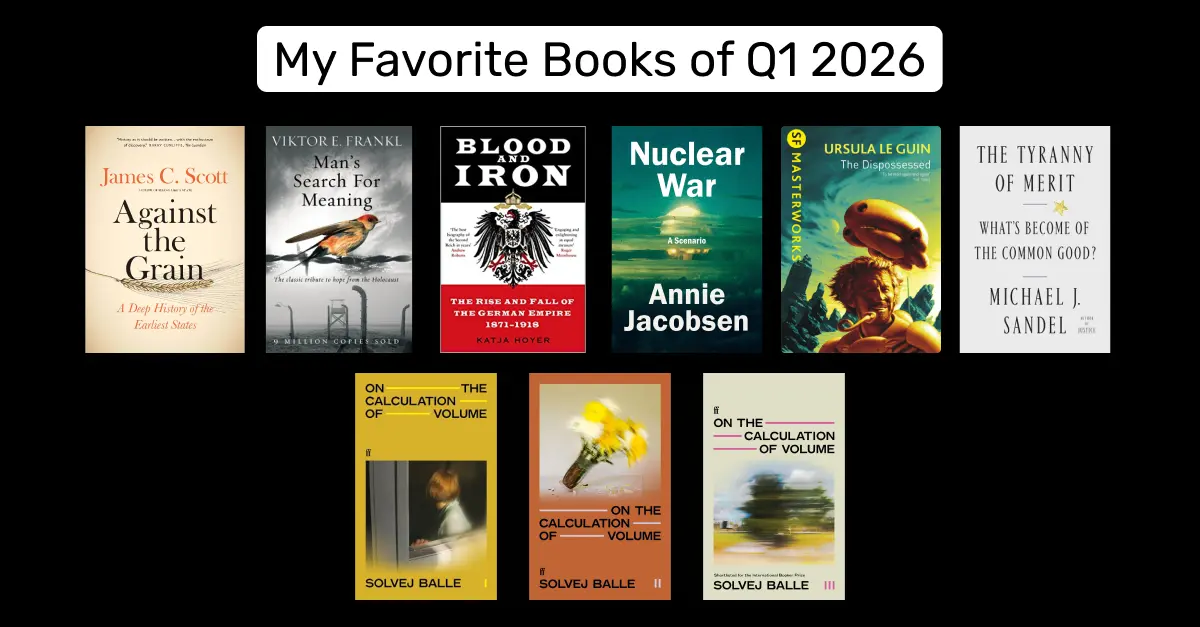
What would you do with the hours you spend reading the news every day? I found out this year. In the first three months of 2026, I finished 19 books, which is almost as many as I read in the whole of 2025. Turns out, staying informed is expensive.
Last year, I was writing a blog post after every quarter covering books, movies, TV shows and games. This year, since I read so many books, I decided to just write about the books I liked after each quarter. You are reading the first one of this series.
Against the Grain: A Deep History of the Earliest States
I enjoy reading about history, especially when it opens my eyes on a very specific topic. Against the Grain by James C. Scott was that kind of book. Most people think of agriculture as a natural step forward in human history and as the foundation of how human society developed. But when you read this book, you see that agriculture was not something people really wanted to do. It required too much work and led to the birth of states, which meant paying taxes and working in other people’s fields. You even learn that the walls built around those early states were not only to protect people from enemies, but also to keep the people living nearby inside so they would work the fields and pay their taxes.
Another thing I liked about this book was how it challenges the common idea of barbarians. When we think of barbarians today, we only think of negative things. But those people were actually the real rebels who did not want to live under the rule of those early states or spend their days working on farms. They simply wanted freedom, without being forced to work and pay taxes. Since history was written by the people living inside those states, we never got to hear the barbarian side of the story. We still see them as the enemy.
If you are interested in history, this one is hard to put down. You will also never look at a loaf of bread the same way again.
Man’s Search for Meaning
When I first heard about this book, I was surprised that most people around me had already read it and I had somehow missed it. Man’s Search for Meaning by Viktor E. Frankl is about the author’s own experience in the concentration camps. I have watched many documentaries about the Second World War and I know about the horrible things that happened during that time, but what I read in this book was on a completely different level. The author is a psychologist, so he does not just write about his feelings but also about his observations as a psychologist.
The second part of the book focuses on logotherapy, which is a school of psychotherapy that sees the search for meaning as the central driving force in human life. That part resonated with me a lot, because finding meaning in my life is something I think about often.
It is very short but emotionally quite heavy. If there is one book on this list that I think everyone should read at some point in their life, it is this one.
Blood and Iron: The Rise and Fall of the German Empire 1871-1918
Since I have been living in Germany for a long time, I wanted to learn more about German history and ended up with Blood and Iron by Katja Hoyer. History books can be quite boring, but this one was very well written. The book mostly focuses on Otto von Bismarck and his role in German unification. I knew a little about him since there is a very tall monument of him in Hamburg. I always wondered what made him worthy of that kind of honour, and now I know why.
After covering German unification, the book shifts to the political environment and social life, and how the empire slowly built a nation. You even discover things like the origin of why all shops are closed on Sunday in Germany. A lot of the things I observe here started to make more sense to me after reading this book.
At the end, you also see the beginning of the First World War and how things developed over time, including all the lives sacrificed by the Kaiser while he enjoyed a peaceful life even after the war ended. It left me with a strange feeling, knowing that some of the patterns from that era are not as distant as we like to think.
On the Calculation of Volume I, II, III
Last year, I noticed I was not reading much fiction, so I wanted to change that. Based on a recommendation from a friend, I started On the Calculation of Volume by Solvej Balle. The book is about a woman who is stuck living the same day, the 17th of November, over and over again. It is a fascinating story, but what I liked most about it is that because she lives the same day every day, she starts to notice every small detail of life. From the movement of clouds to the sounds her husband makes at home.
While reading this series, I noticed that I also started to appreciate the small details in my own daily life, from birds to the behaviour of people around me. That shift in attention felt like an unexpected gift from a book about someone trapped in time. I have already read the first three books of this seven book series and the fourth one is coming out very soon.
Nuclear War: A Scenario
I heard a lot of positive things about this book from friends, so I gave it a try and could not stop reading it. Nuclear War by Annie Jacobsen focuses on a scenario where North Korea fires a nuclear missile at Washington, and what unfolds right after it is detected. The author interviewed many people to get things as accurate as possible, so while reading the book you are both horrified and surprised by what would actually happen if a single nuclear missile were fired today.
What stayed with me after finishing it was not the scale of the destruction, but how little time anyone would have to make decisions, and how many of those decisions are already made in advance by automated systems. I hope the scenario in this book never happens, but when I look at what is going on in the world, I always feel there is a small chance it could.
The Dispossessed
A friend pointed out that I had never read anything by Ursula K. Le Guin, so I decided to start with one of her most well known books, The Dispossessed. It is about a scientist who travels to a sister world after making a scientific breakthrough. That world has a completely different political system from his own. I would not be wrong in saying that while his world leans more toward communism, the world he visits leans more toward capitalism. But unlike most books that would take one side, this one perfectly shows the flaws of both systems, as well as the role of women in each world.
I already ordered another book by Le Guin before I even finished this one. That should tell you enough.
The Tyranny of Merit: What’s Become of the Common Good?
If you are confused, like I am, about the growing inequality in the world and the rise of far right parties, this book might help. I first heard about The Tyranny of Merit by Michael J. Sandel from Olaf Scholz, the former chancellor of Germany, in an interview. The book focuses on meritocracy and how it divides people into two groups: the educated and the non-educated. Over time, politicians started praising meritocracy and pushing the idea that everyone should study, not just for a bachelor’s degree but all the way to a PhD. Of course, not everyone can do that, and the ones who did started to form their own class, separate from those without higher education, and began to control many aspects of life. On top of that, they do everything they can to make sure their children have the same advantages.
Even though the book mostly focuses on the US, you can see the same patterns in European countries and in Germany too. It covers the last four decades and shows how the makeup of political parties changed. In the past, you would see workers in parties like the Social Democrats or the Labour Party. Today, you mostly see people with PhDs. This creates a big problem: since only a small group of highly educated people are running things, those without higher education feel left behind. People with PhDs often cannot relate to the problems of everyone else, so they fail to come up with solutions that work for most people. In the end, those who feel ignored look for alternatives, not because they believe those other parties can fix their problems, but because they have lost hope in the established ones.
I especially recommend this one if you already consider yourself highly educated. It is a little uncomfortable in the best possible way.