Before diving into what a city super app is, let’s first explore the concept of a super app itself and why it’s becoming essential in modern digital life.
What is a Super App?
Super apps are not a new concept. They’re more common in Eastern countries, which is why you may not be as familiar with them in the West. In Southeast Asia, for example, the most well-known super app is WeChat in China. On WeChat, you can access social media, payment tools, online shopping, ride-booking, travel bookings, and food delivery — all within a single app.
The success of WeChat inspired many startups in the West to explore the super app concept. While no app has reached WeChat’s level of integration, several are heading in that direction:
- Uber: Started as a ride service and now offers food delivery, package delivery, and groceries.
- Wolt: Began with food delivery and now includes package and grocery delivery, with plans to offer banking and payment services.
- Revolut: Started as an online bank and now provides investment tools, insurance products, eSIM data plans, and travel services.
Some argue that this model benefits companies because they don’t have to spend much to acquire users for new services, and they can gather more data. It’s also convenient for users since they can access many services from one place.
However, others warn that when users stay within a single app, they might miss out on better services or lower prices available elsewhere. If one service within the app fails, users could lose access to several other services they rely on, such as their bank account.
I’m not sure if this model will work in the long run, but I do believe that the core services these apps were originally built for will suffer over time. As companies focus more on adding new features and growing their user base, they may stop improving the services they were originally known for.
What is a City Super App?
Now that you understand what a super app is, you can probably guess what a city super app might be. It’s an app that brings together everything about a city. But what exactly do I mean by everything? That’s the exciting part — it can include anything that’s related to the city.
So, what makes a city a city? It’s not just the buildings and streets, but its legal status and how it’s governed. I live in Hamburg, which is a city-state, so elections are an important part of civic life. This would be a good starting point for a city super app. You could access information on local parliament members, find out how to reach them, ask questions, check past election results, and view upcoming election polls. These features help you engage with your community and participate in your civic rights.
But why would you need an app for your city? The goal is to make city life easier. Maybe you enjoy long walks and want to find public toilets or water stations without searching around. Or maybe you need to charge your electric vehicle or find a pharmacy at night. A city super app can bring all this information together in one place. Sure, you can find this information on separate websites, but that’s the problem. You have to search for it, verify the data, and wade through ads or poorly designed pages. All you want is to find a place to pee or charge your car.
Beyond these basic needs, a city super app can help you discover more about the city. Nature spots, playgrounds, bike routes, festivals, public libraries, coffee roasters, and more. You might know websites or Instagram pages for some of these, but they don’t offer a single place to explore everything without pushing products or promotions. A city super app solves that problem. Whenever you need something or want to discover a new part of the city, you can simply open the app.
Franzbrötchen – Hamburg City Super App
A few years ago, I had the idea for a city super app. Thanks to my friends and colleagues, I’ve learned a lot about Hamburg. Over time, I met more people and realized not everyone knows as much about the city as I do. So, I thought: Why not create an app that collects everything I know about the city? I started by writing down everything in the Notes app.
I shared the idea with my friends, and they agreed that an app like this could be really helpful for many people. Over the past few months, I began developing the app. Every day, I’d work on a new section, sitting in a café for a couple of hours. By the end of October, I launched it. The response on Reddit and LinkedIn blew me away. People loved the app and the idea behind it! I guess I proved once again that people often don’t realize what they need until it’s right in front of them.
I named the app Franzbrötchen because it’s a famous pastry in Hamburg, made with cinnamon and sugar. It’s delicious, especially when you get it from a local bakery, not the big chains. People really liked the name!
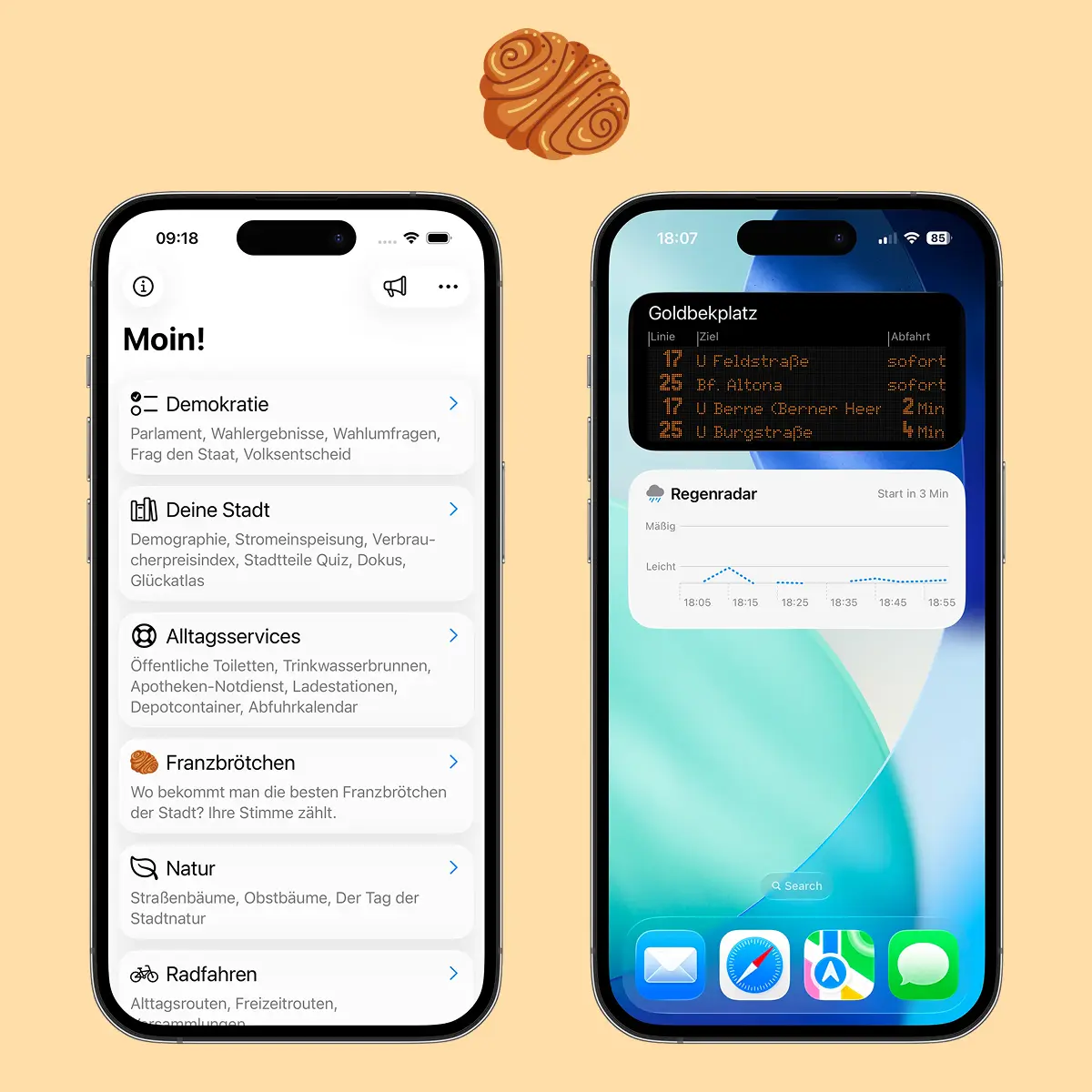
Here are some of the categories in the app:
- Democracy: Ask questions to local parliament members, check election results, track petitions, and more.
- Your City: City demographics, a district quiz game, electricity production sources, consumer inflation rates, and more.
- Everyday Services: Pharmacies, EV chargers, post boxes, water dispensers, public toilets, garbage collection times, and more.
- Nature: Street trees, fruit trees, nature reserves, and more.
- Cycling: Commute routes, recreational bike paths, group meetups, and more.
- Rain Radar: A must-have in Hamburg, much more accurate than Apple’s default weather app.
- Culture: Cinemas, theatres, museums, art galleries, and more.
- Regional: Weekly markets, farms, coffee roasters, breweries, and more.
This list goes on. There are probably hundreds of things I could add to the app, but for the initial release, I focused on what would help people understand the concept. Over time, I’ve added more features, and many users have suggested new ideas I hadn’t even thought about. The app has even helped me discover things I didn’t know about my own city!
Now, I have a long list of features to add in the future, which will keep me busy for the next few years. It’s time-consuming, but I believe it’s my way of giving back to the community I enjoy living in. The app is completely free and has no ads. I don’t track any user data, and unlike most apps, I don’t focus on engagement. My main goal is to help people solve problems and discover more about their city.
When it comes to data, I’m lucky that there’s a law in Germany (Datennutzungsgesetz) requiring public offices to share non-personal data in machine-readable and open formats. This is where I get most of the data for the app. I also curated some of my own lists and linked to non-profit organizations’ websites when necessary. This combination ensures that the data in the app is reliable and verifiable. Of course, sometimes the data can be outdated because public offices don’t always update it regularly, but since things in the city don’t change that often, the information is usually up-to-date.
Enter Large Language Models
Before ChatGPT and other large language models, there were three main ways people accessed information online:
- Search engines: You knew what you were looking for and typed a few keywords into a search engine like Google.
- Social media: You followed people—either friends or influencers—and stumbled upon information when they shared something worth seeing. (Twitter, Instagram, Youtube, etc.)
- Forums and Q&A sites: If you had a specific question, you asked it in a forum or Q&A platform like Reddit, Quora, or Stack Overflow, where people with expertise would answer.
These channels have changed a lot in the past few years. Companies figured out how to manipulate them to make money. As a result, they started showing more ads, requiring accounts, and making the platforms addictive, so people spent more time on them and saw even more ads.
Then, in 2022, ChatGPT arrived. What ChatGPT did was scrape the entire internet and offer a new way to access information. Instead of searching for keywords, you could ask full sentences and get an answer right away. You didn’t need to wait for someone to respond or sift through multiple answers. It was like having a conversation with a knowledgeable friend.
But there’s a downside to ChatGPT. Since you interact by chatting and only get one answer, unlike search engines or forums, you might assume the answer is correct and not look for other options. ChatGPT generates responses based on what’s most commonly mentioned in its training data, but sometimes it can be wrong or even create hallucinations. That’s just how the system works.
So, what does this have to do with a city super app? Some people might think that ChatGPT could replace a city super app, but the problem I mentioned above still applies. While ChatGPT offers a more conversational way to access information, you can’t always trust the answer. For example, if you ask for your district representative’s name, ChatGPT might get part of the answer right, but not the full, correct answer. This is where a city super app integrated with a voice assistant could solve the problem.
Instead of Siri trying to answer questions about Hamburg based on its own model or the internet, it could pass the question to my Franzbrötchen app. Since most of the information in my app comes from official sources or non-profits that focus on accuracy, Siri could deliver a 100% correct answer.
The good news is that Apple is already building the system I’m talking about with App Intents. While it’s not perfect yet, when apps like mine integrate with this system and Siri gets its long-awaited update next year, I believe this will change how people access information on their digital devices in a couple of years.
How Will It Be Sustainable?
You might be wondering how a city super app can be sustainable, given the amount of time and effort required to build it. Well, I believe these apps will either rely on donations from users (like mine) or receive public funding. Companies offering voice assistants might also pay apps based on the number of queries answered.
I don’t think any big company can create a city super app for every city in the world and guarantee reliable information. This is why I believe every city will need to create its own. A company based in California can’t create a better app or service for a city thousands of kilometers away. The locals know their city best. We’ll have to see how this all plays out.